What Is a Proffie Lightsaber, Exactly?
Proffie lightsabers are essentially any sabers that are made using the ProffieBoard - an open-source soundboard that originated in the lightsaber-hacking community (the project dates back to the work of Fredrik Hubinette, one of the first creators of DIY saber electronics). It is not produced by a single company with a closed product but an open platform that hobbyists and builders have taken years to perfect.
When people ask what makes a Proffie lightsaber special, it usually comes down to a handful of things:
It's deeply customizable. Because the firmware (ProffieOS) is open-source, builders can write their own configuration files instead of being stuck with whatever a factory programmed in. Blade colors, ignition style, gesture behavior, button mapping — almost all of it can be rewritten.
The sound is genuinely better. Proffie boards can run more audio channels at once, which means your hum, swing, and clash sounds layer properly instead of cutting each other off mid-effect. It sounds small until you hear it side by side with a basic board — then it's not small at all.
Sound fonts are a huge deal here. A sound font is basically a themed audio pack — hum, swing, clash, ignition, retraction, all bundled together to give your saber a personality. Want your saber to sound like it's barely holding together, crackling and unstable? There's a font for that. Want something clean and Jedi-classic? Also, a font for that. The Proffie community has built up a genuinely huge library of these over the years.
Gestures actually work well. Flick to ignite, twist to change color, that sort of thing — Proffie's motion handling tends to be more reliable than what you get on cheaper boards.
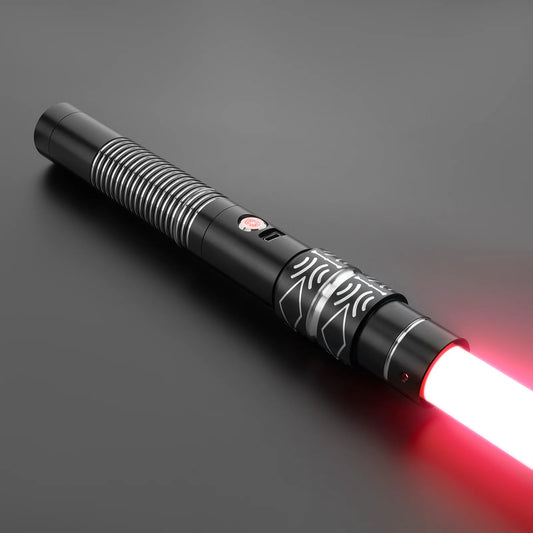
Effects line up properly with a Neopixel blade. Clash flicker at the exact point of impact, smooth swing shimmer, clean transitions between colors — this is where Proffie and Neopixel really earn the "proffie neopixel lightsaber" combo reputation as close to top-of-the-line as the hobby currently gets.
A Quick Word on Proffie 2.2
If you're shopping around, you'll keep running into "Proffie 2.2 lightsaber" in listings. That's the current, most widely used generation of the board. It's not the flashiest name, but it's the one most builders trust — better audio amplification than earlier versions, more reliable motion sensors, more memory for sound fonts, and firmware that's had years of bugs ironed out by the community. If a saber is described as running Proffie 2.2, you can generally expect it to be a stable, well-supported build rather than something still being figured out.
Does Proffie Actually Hold Up for Dueling?
Yes, and this is one area where it genuinely pulls ahead. A few reasons:
- Clash detection tends to be more precise, so the flicker actually matches where contact happens instead of just triggering somewhere random on the blade
- Multi-channel audio means the hum and swing sounds don't get cut off awkwardly mid-combo when you're moving fast
- Motion sensing is more dialed in, so you get fewer false triggers during aggressive choreograph
- There's a decent-sized library of dueling-focused configuration files shared by other builders, some even set up for stunt-style force feedback on supported hilts
If you're part of a costuming group, doing choreography, or just duel seriously with friends, Proffie tends to be the board people gravitate toward once they've outgrown basic RGB.
Why Do Proffie Sabers Cost More?
There's no way around it — a proffie neopixel lightsaber build is going to cost more than a basic RGB or entry Neopixel saber. A few honest reasons why:
- The board itself costs more to produce than a simple RGB controller
- Setting one up properly — wiring, flashing firmware, loading sound fonts, calibrating sensors — takes real time and skill, and that labor isn't free
- Builders usually pair Proffie boards with better blades, speakers, and hilts, because if you're going to the trouble of a premium brain, you might as well match it with premium parts
- Ongoing firmware development and community support add real value, even if it's less visible than the hardware
It's a bit like comparing a point-and-shoot camera to a mirrorless one. Both take photos. One just gives you a lot more control if you're willing to learn it — and that control isn't free.
Can You Actually Customize a Proffie Saber?
Yes, and this is genuinely the main selling point. Once you've got one, you can adjust:
- Blade colors and full color profiles, including multi-color effects
- Sound fonts, swapping your saber's entire personality in minutes
- Gesture controls, deciding what a flick, twist, or shake actually does
- Blade styles beyond flat colors — pulsing, cycling, "unstable" stunt-double looks
- Button mapping, right down to specific combinations
Because it's open-source, there's a whole community constantly building new configs, fonts, and blade styles you can just download and drop in. That's a completely different experience from a closed system where you're stuck with whatever the factory shipped.
Adding New Sound Fonts — Is It Complicated?
Not really, once you've done it once. Sound fonts usually come as a folder of WAV files (hum, swing, clash, ignition, retraction, etc.) named in a way the Proffie firmware recognizes. Generally, the process looks like:
- Download a sound font (plenty are free from the community; some premium packs cost a bit)
- Copy the folder onto the SD card your board uses
- Tweak the blade style config if it needs to reference the new font
- Reboot the saber
That's genuinely it. No soldering, no opening the hilt. Your saber can sound like a completely different weapon in under ten minutes.
So Who Should Actually Buy One?
Not everyone needs to start here, and that's okay.
Proffie makes sense if you:
- Want the most realistic sound and blade behavior currently available
- Actually enjoy tinkering with settings and config files (or want to learn)
- Duel seriously or do choreography/performance work
- Want the option to keep adding sound fonts and blade styles down the road
Are building a serious, long-term collection
Stick with RGB or basic Neopixel if you:
- Are brand new to the hobby and just testing the waters
- Have a tighter budget
- Want something fun for cosplay or casual use without fussing over settings
Honestly, a lot of people's path looks like: buy something basic, fall in love with the hobby, then upgrade to a Proffie build once they realize what they've been missing. There's nothing wrong with starting small.
Worth a Look
Two sabers worth checking out if you're browsing right now: the Ezra Bridger Green Lightsaber, a detailed hilt pulled from the Star Wars Rebels aesthetic that pairs a screen-accurate look with serious internals for fans who want both style and substance, and the LGT Saber Nexussabers RGB Changing model, which leans into vibrant, adjustable color effects at a friendlier price point for anyone not quite ready to jump into Proffie territory yet.
They sit at pretty different ends of the spectrum, which is kind of the point — one's about character accuracy, the other's about flexible color performance on a budget.
Want to Go Deeper?
If you are considering creating or purchasing some equipment for Proffie Lightsaber, then our article — Proffie Neopixel Lightsaber Guide: Advanced Sound, Smooth Swing, and Ultimate customization — provides information on blade style configuration and sound font installation in further detail. Make sure to read it once you are clear on the path you want to take. Also, don't forget to check our related article - What is a Proffie Lightsaber? A New Era of Lightsaber Technology.
Conclusion
So, what is a Proffie lightsaber? It's not the blade, and it's not a brand you'll see stamped on the hilt somewhere. It's the electronics running the whole show — the thing deciding how your saber sounds, how it reacts to a clash, and how far you can push its customization. Pair that board with a Neopixel blade, and you've got what most of the hobby considers as close to "as good as it currently gets."
RGB sabers are still a completely reasonable place to start. Basic Neopixel splits the difference nicely. But if you want the most immersive, duel-ready, endlessly tweakable experience out there, a proffie neopixel lightsaber running Proffie 2.2 is probably where you'll end up eventually anyway.