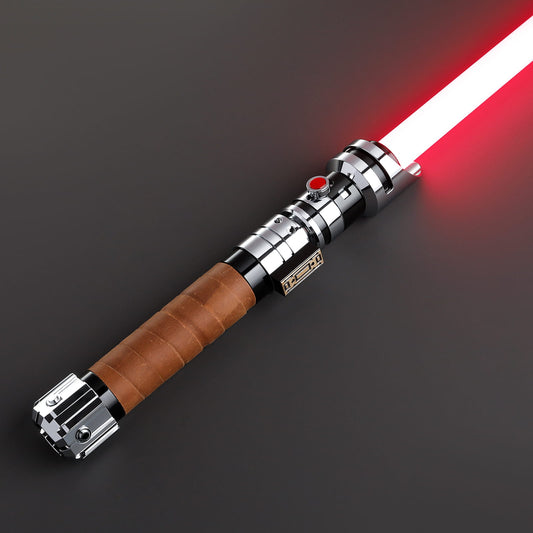
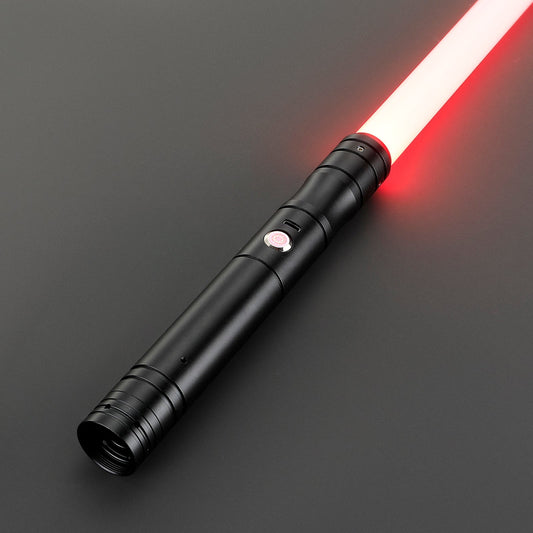
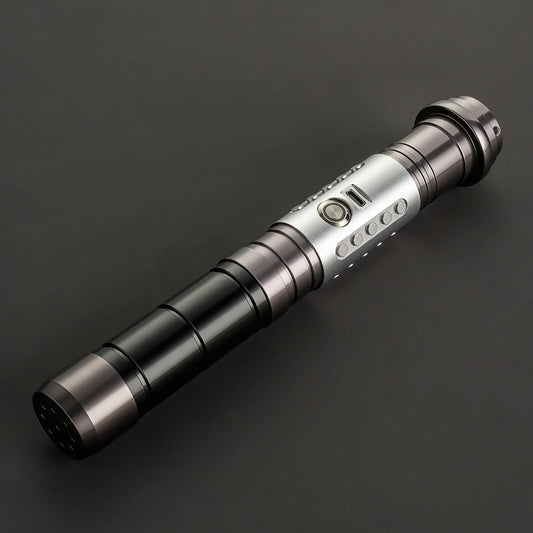
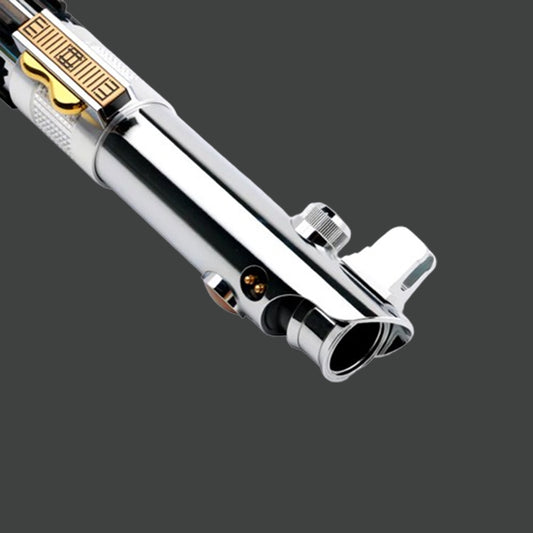
Ask ten lightsaber owners which is better, Neopixel or RGB, and you'll probably get eleven opinions. It's one of the oldest arguments in the hobby, right up there with "which hilt style is the most comfortable to hold" and "is a shto oki blade too heavy for real dueling." Both technologies have their fans. Both look great in the right hands. But they're genuinely different pieces of engineering, and that difference shapes everything from how your saber lights up to how much you'll pay for it.So let's get into it. This is a full breakdown of neopixel lightsabers versus RGB lightsabers — how they work, where each one wins, and which type actually makes sense for you, not just for some hypothetical "average buyer."
First, What Are We Even Talking About?
Before attempting a comparison between these two concepts, it is essential to comprehend what those terms really mean since many buyers tend to use them although they haven't realized the difference.
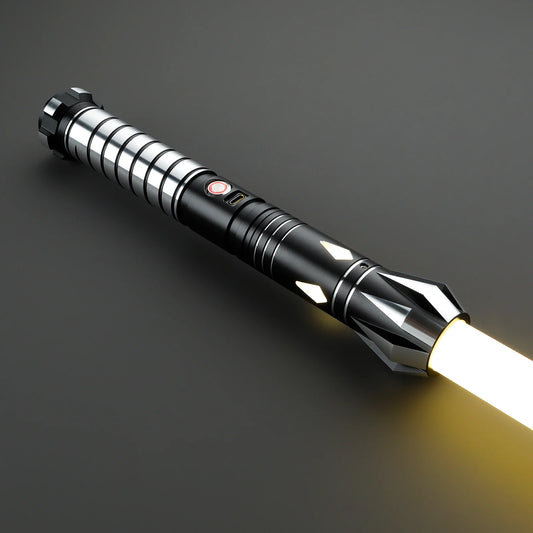
Neopixel lightsabers feature SMD LED strips of WS2812B type along the length of the sword blade. Each LED on the strip operates independently, thus allowing the saber controller to create effects that travel along the lightsaber blade, such as igniting the blade animatedly from its hilt to the end, flickering of the plasma illumination, and clashing effects that are produced at the moment of impact.
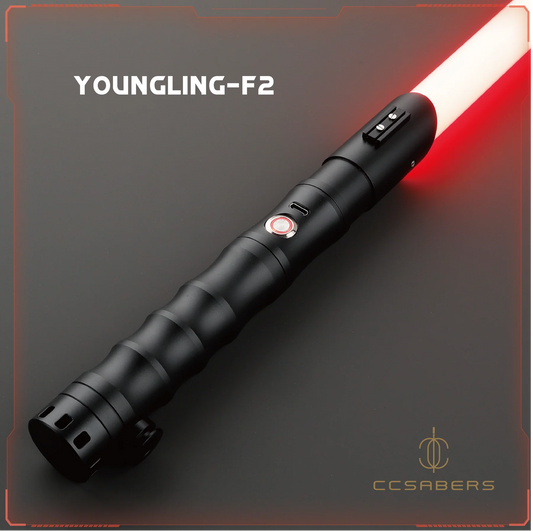
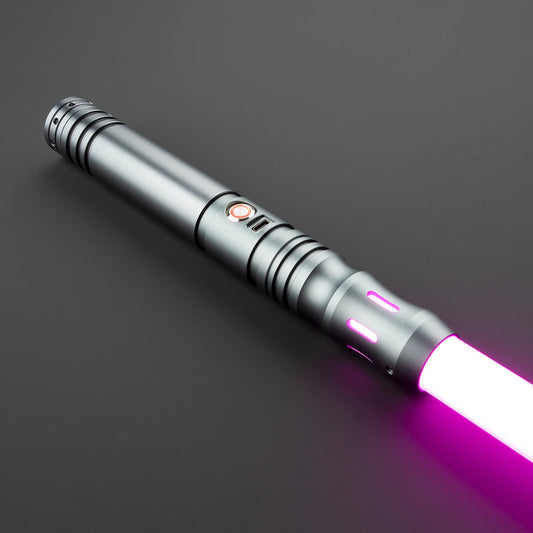
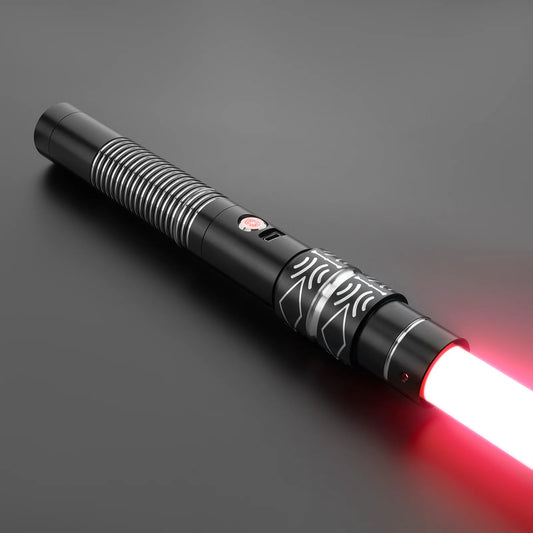
RGB lightsabers do this differently. Usually, these sabers use one RGB LED or a cluster of RGB LEDs; that is allowed to light through the polycarbonate blade that works as an ordinary optic fiber – it takes its light from the LED at the base of the hilt, thus simplifying things.
Neither approach is "fake" or inferior on paper. They're just built differently, and that changes what you get in practice.
Is a Neopixel Blade Really Brighter?
Mostly, yes. Because a Neopixel blade has light sources spread across its entire length, you don't get that gradual dimming effect you sometimes see toward the tip of an RGB blade — the light doesn't have to travel as far from a single point. In photos, in videos, and especially in a dark room during a duel, that consistency makes a real difference. It's the kind of thing you don't notice until you see it side by side with a saber that doesn't have it, and then you can't unseen it.
To be fair, a well-made RGB blade with good LEDs and proper light piping can still look plenty bright for most people's purposes. If you're mostly displaying the saber or taking photos indoors, you might not even notice the difference. It only really becomes obvious under stricter comparison or in low light where every bit of brightness counts.
Can You Actually Duel With an RGB Saber?
This one gets debated a lot, and honestly, the answer isn't as simple as "no, buy Neopixel." It depends far more on how the individual saber is built than on which LED technology is inside it.
Cheap RGB sabers usually cut corners somewhere — thin blade walls, weaker hilt materials, sloppy internal wiring — and those are the ones that crack after a few hits. But there are dedicated RGB dueling lightsaber models out there built with thick polycarbonate blades, reinforced hilts, and dueling-grade electrical connections that hold up just fine in choreography or light sparring.
If dueling matters to you, don't just filter by "Neopixel vs RGB." Look at the actual build specs: blade wall thickness, hilt material, how the blade locks into the hilt, and the quality of the soldering inside. A poorly made Neopixel saber will snap just as fast as a poorly made RGB one. Buy from a place that specializes in lightsabers and actually tells you what's inside, not a generic listing with stock photos and vague descriptions.
So, Why Do Neopixel Sabers Cost So Much More?
A few reasons, and they add up fast.
The LED strip itself costs more than a single RGB LED, obviously — you're paying for dozens of individually controllable lights instead of one. But that's really just the start. Running all those LEDs independently and syncing them with sound in real time requires a much more capable sound board. Basic RGB controllers just aren't built to handle that kind of processing.
Then there's assembly. Installing an LED strip evenly along the inside of a blade, soldering it correctly, and making sure it doesn't flicker or fail under stress takes real skill and time — a lot more than wiring up a single LED at the hilt. And if you're going the custom route, with your own color choices, sound fonts, and hilt combination, you're essentially paying for a semi-custom build process rather than something off a shelf.
None of that makes RGB "cheap" in a bad way — it just means the manufacturing complexity is genuinely lower. Whether the price gap is worth it comes down to what you actually want out of the saber.
Custom Neopixel Lightsabers: Building It Your Way
Neopixel distinguishes itself from others when it comes to the options offered to collectors. Neopixel lightsabers with an extensive degree of customization give you lots of options, such as color choices for your lightsaber or colors that you can switch between during use, the type of hilt you need and finish, sound fonts, cool effects like clash flicker or blaster deflection, and even blade length suited to your size and your style of fighting.
That being said, if you are creating a themed collection, or a fighting saber of a specific character you have in mind, this degree of flexibility matters. It shows the difference between "satisfactory" and "ideal." When you want to know more about custom-built sabers — their colors, sound schemes, options, etc. — it is better to explore sites such as bmlightsabers.com than buy them from an ordinary marketplace.
What About Double-Bladed Builds?
If you're a Darth Maul fan (and let's be honest, who isn't a little bit), a Neopixel double-bladed lightsaber is probably on your wish list. These have two full Neopixel blades coming out of opposite ends of the hilt, each one capable of its own ignition sequence, its own lighting behaviour, and synced sound.
Because Neopixel gives you that much control, a double-bladed build can do things like ignite both blades at once for a dramatic reveal or fire them off one after another. The brightness stays consistent across both blades too, which is something double-bladed RGB sabers often struggle with — you end up with two separately light-piped blades that don't always match in intensity.
The trade-off is power draw. Running two full Neopixel blades needs more robust wiring and a beefier battery than a single-blade build, which pushes the price and weight up a bit. Still, for the visual payoff, most people who go double-bladed say it's worth it.
For a deeper look at how different Neopixel blade configurations stack up, check our related post: Neopixel Darksaber vs Neopixel Lightsaber — which lightsaber should I buy: Neopixel or RGB?
Sound: The Part People Underrate
Everyone talks about the light, but honestly, the hum is half the experience. That low, steady thrum, the crackle when blades clash, the whoosh on a swing — get that wrong and even the best-looking blade feels hollow.
Neopixel sabers generally win here too, though it's a bit of a secondary effect. It's less about the LEDs themselves and more about the fact that Neopixel builds are almost always paired with premium sound boards — the kind that can sync audio directly with the lighting animations. That's what gives you a hum that flickers along with the blade, a clash sound paired with a localized light flare right where it happened, or swing sounds that respond to how fast and hard you're actually moving.
RGB sabers can still sound great if they're paired with a decent sound board. But a lot of budget RGB models cut costs here too, using simpler, less responsive audio systems. If sound quality matters to you as much as the visuals, don't just look at the LED type — ask specifically what sound board is inside.
Which One Should a Beginner Actually Buy?
To be honest, it all comes down to the reason you started this hobby in the first place.
Choose RGB if you're tight on resources, just want something to help out with photography or cosplay, you're not sure of how deep you're going to get into the hobby, and you just need something straightforward and easy to start using.
Choose Neopixels if you know for certain that you'll be dueling quite often, you're looking for the most realistic and satisfying lighting and sounds, you're willing to put in a little more money at the beginning for sturdier materials and construction, and you're looking for something original instead of an off-the-shelf preset.
Many experienced collectors will suggest you get an RGB lightsaber first to gain some experience, practice a little with basic maintenance of the saber, and maybe even some dueling before investing serious money into a Neopixel lightsaber. This advice is not bad at all. However, if you have the resources and know for sure that you want the full experience with lightsabers, there is no need to start small.
So… Neopixel or RGB?
There's no single right answer here, and honestly, anyone who tells you there is probably has something to sell you. It comes down to priorities.
If you want the most realistic lighting, better sound sync, and the option to fully customize your build, Neopixel is going to get you there — you'll just pay more for it. If you want something solid, functional, and easier on the wallet, a well-made RGB saber will absolutely do the job, especially if display or light cosplay is your main goal. And if a double-bladed saberstaff is calling your name, a Neopixel double-bladed lightsaber is really the only way to get that dual-ignition effect done right.
A lot of collectors, honestly, end up owning both eventually — an RGB saber for casual use or backup, and a Neopixel build reserved for the serious stuff. There's no rule saying you have to pick just one.
Before you decide, think about how you'll actually use it. Mostly for photos and shelf display? Planning to duel regularly? Building toward a specific character's setup? Your answer to that question will steer you toward the right saber far more reliably than any spec sheet will.
Maintenance: What Happens After the Purchase?
Buying the saber is only step one. How it holds up depends a lot on how you treat it — and a little on which type you bought.
Neopixel blades pack more delicate electronics into a longer stretch of the saber, so they need a bit more care. Avoid twisting or bending the blade hard, keep an eye on connectors and solder points if it's a custom build, and store it in a case when it's not in use instead of just tossing it in a closet. Battery packs, especially on double-bladed builds, may need charging more often depending on how much you're running the effects.
RGB sabers, with fewer moving electronic parts, tend to be a bit more forgiving. Replacement parts — a single LED, a basic sound board — are usually cheaper and easier to find if something does go wrong. The catch is that cheaper RGB blades can crack under repeated impact more easily, particularly ones that were never designed with dueling in mind.
Either way, follow whatever care instructions came with your saber and don't treat a display piece like a practice weapon. It'll last a lot longer.
Power and Battery Life
Worth a quick mention: Neopixel strips draw more power than a single RGB LED, simply because there are more individual lights to run, especially when animations like flicker or clash effects are firing constantly. That means Neopixel builds — again, especially double-bladed ones — often need higher-capacity batteries, and runtime can vary quite a bit depending on how much you're using the fancier effects. RGB sabers, by comparison, sip power and often run longer between charges for casual use.
If you're planning long dueling sessions, convention appearances, or extended photo shoots, it's worth checking the battery specs before you buy rather than finding out the hard way mid-event.
What Do Collectors Actually Say?
Spend any time in lightsaber forums or Discord servers, and you'll see this debate play out constantly. Neopixel fans talk about the immersion — that smooth blade flicker synced perfectly with a clash sound is hard to go back from once you've experienced it. RGB fans push back on the idea that you need all of that, pointing out that plenty of people just want a good-looking, reliable saber without paying a premium for effects they may not use much anyway.
Where almost everyone agrees, though, is that build quality matters more than the underlying LED tech. A badly made Neopixel saber will let you down just as fast as a badly made RGB one, and a well-built RGB saber can outperform a cheap Neopixel build any day. The technology is only half the story — who actually built the thing matters just as much.